Precession and Avalanches
Recently Deutsch has done work with Andreas Berger, formerly of Hitachi
Global Storage Technologies, and now Research Director of Nanogune,
to study the way the microscopic spins in a magnetic materials move,
such as materials that are used in hard disk drives. In particular,
we examined the
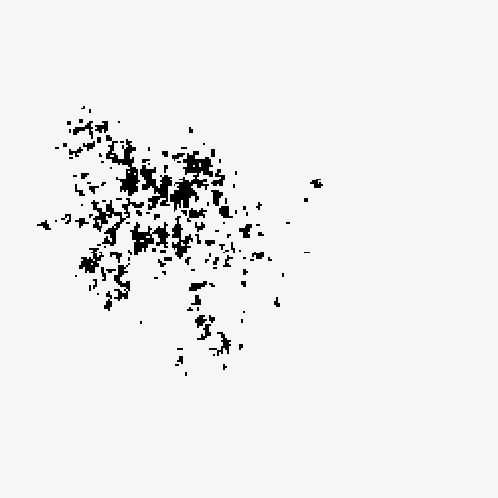
On the right you can see an avalanche of a material with small damping. Note in the above snapshots, how spins far away from the growth front spontaneously avalanche. This is due to spin waves heating up regions far ahead of front.
Using this technique we explored much larger systems than would otherwise be possible. We showed that low damping systems can also alter qualitatively the morphology seen in avalanching magnets. In some cases disjoint avalanched cluseters are seen, as illustrated on the right. We were also able to determine how the effective critical properties of avalanches alter for low damping three dimensional systems. On small and intermediate scales, They appear substantially different from relaxational dynamics. Multicycles Deutsch has worked with Onuttom Narayan on hysteresis curves in spin
systems. It had been assumed that at low temperatures,
an adiabatic hysteresis loop closes back on itself in steady state. They showed
that in many circumstances this is incorrect and the system goes
through multiple cycles before it returns to its initial state. Such
behavior may be observable in spin glass materials at low temperatures
and would show an interesting subharmonic response to an oscillating
magnetic field. Later in collaboration with Narayan and also a graduate
student, Trieu Mai, they showed
that in a realistic model of nanopillars,
it was possible to also see these multicyles.
Clicking on the picture to the right, you can see an mpeg movie of a set of
nanopillars in an applied field that is slowly varied between two moderate
values of field. Watch the blue third spin in the first column. It flips only
every other cycle.
Deutsch has worked with Onuttom Narayan on hysteresis curves in spin
systems. It had been assumed that at low temperatures,
an adiabatic hysteresis loop closes back on itself in steady state. They showed
that in many circumstances this is incorrect and the system goes
through multiple cycles before it returns to its initial state. Such
behavior may be observable in spin glass materials at low temperatures
and would show an interesting subharmonic response to an oscillating
magnetic field. Later in collaboration with Narayan and also a graduate
student, Trieu Mai, they showed
that in a realistic model of nanopillars,
it was possible to also see these multicyles.
Clicking on the picture to the right, you can see an mpeg movie of a set of
nanopillars in an applied field that is slowly varied between two moderate
values of field. Watch the blue third spin in the first column. It flips only
every other cycle.
Field Asymmetry in domain patternsExperimental work using x-ray speckle techniques has discovered a very surprising asymmetry in patterns seen in a hysteresis loop. A two dimensional thin film is placed in strong perpendicular magnetic field which is slowly lowered. The speckle patterns are observed as a function of the applied field. The same experiment is done starting with the opposite field and raising it. The patterns seen are statistically different. This is despite the fact that the
Hamiltonian is spin inversion symmetric.
are statistically different. This is despite the fact that the
Hamiltonian is spin inversion symmetric.
The experiments have many other interesting features to them. A range of films were used with different degrees of disorder. At the lowest disorder, snake-like growth of domains was observed to spontaneously occur at some threshold field giving rise to a cliff in the hysteresis loop. This cliff disappeared for higher disorder films. Again in collaboration with Trieu Mai, Deutsch showed that all the major features of these experiments could be understood quite well using a model of this system. The key realization is that precession causes a field asymmetry in the patterns seen. This counter-intuitive result can be seen theoretically and was confirmed by detailed numerical work. The snake-like growth at low disorder could be understood using this simulation, see the mpeg movie on the right, and looks quite similar to experimental movies. The asymmetry in patterns seen is also seen here and again is similar to what is seen experimentally. |

 Further work with Andreas Berger showed how to incorporate damping in compuationally
efficient way to be able to better explore magnetic systems by simulation
techniques. We were able to alter the dyanamics of the Ising model to
include damping. The method was able to rigorously describe any system at
finite temperature this way by an algorithm that added non-gaussian
noise to system.
Further work with Andreas Berger showed how to incorporate damping in compuationally
efficient way to be able to better explore magnetic systems by simulation
techniques. We were able to alter the dyanamics of the Ising model to
include damping. The method was able to rigorously describe any system at
finite temperature this way by an algorithm that added non-gaussian
noise to system.